Tuesday, July 4, 2017

Revolutionary Forefathers.


 A quick breakdown of ancestors who fought in the revolutionary war.

MAINE
From the Old Broad Bay Bund and Blatt, 1995 Vol 4, Issue 4, pages 92-98
"Waldoboro in the Revolution"


1776      4 Jul The Declaration of Independence was printed and sent to all the ministers of the Gospel in the State, to be publicly read by them on the first Lord's day after its reception, and to be recorded by the town clerks in their respective books. Neither of these requests were carried out in Waldoboro. Dr. Schaeffer ... was the minister at the time and would neither read it nor allow it read in the old meeting house, the only public place then in Waldoboro.

1776      July Through the influence of Jacob Ludwig and Andrew Schenck, it was translated into the German language and by them read to the people, who everywhere received it with rejoicing.

Captain Ludwig commanded troops throughout the war, and that included his younger brother, Joseph Henry Ludwig.  Joseph is my 5th great-grandfather.

   MARYLAND

While I can't actually connect our family to him, in 1776 Lieutenant James Tibbitt of the Maryland Privateers sailed a brigantine called The Wild Duck from the Dutch West Indies to the head of the Elk River (now Elkton Maryland). The ship was packed with gunpowder and shot; most of that was sent to support General Washington's activities in New Jersey.  The ship itself was taken to Philadelphia for a refit by joseph Humphries, and was re-christened as the USS Lexington.  Tibbitt carried letters of Marque throughout the war, for the sloop Independence, and the brigantine Sturdy Beggar.

James is a Tibbitt family name in our lineage; and my Tibbitt line lived between the Sassafras and Elk rivers in Maryland (Cecil County).  He is certainly a relative, if not a direct ancestor.

PENNSYLVANIA
Godfrey Felten served in Captain Phillip Waggoner's Company of the 2nd Regiment of Foot.  Godfrey is my 5th great-grandfather.

There was a John McDermond of Chester County; he is the leading candidate to being the father of James McDermond, and John collected a Revolutionary War pension.  But that's all I've managed to uncover. If this is an ancestor, this would be the sole entrant from my father's line.


Friday, March 17, 2017

Martin Rouse, an Irish Success Story


Martin Rouse was born on May 12, 1829 in Maugherabrack, in the parish of Kilglass, in county Sligo, Ireland. He was the son of Thomas Rouse and Margaret "Peg" Taylor.  His brother John was born two years later, and then around 1837, the family immigrated to America.

In the 1850 United States Census, he was still living with his parents in New York City.  He was working as a cooper, while his brother was a cartman. A year later, he was sworn in as a naturalized citizen of the United States.

36 & 38 Whitehall Street
By 1860, he had married Sarah Douglas and moved to Jersey City.  Although still listed as a cooper, by this time he had partnered with a tallow chandler named Goulard.  By 1870, the firm of Goulard, Rouse & Company had offices on Whitehall Street in New York, as well as Kansas City and Chicago.  He was a founding member of the New York Produce Exchange, and also served as the Chief Weigher for the Port of New York.

As Chief Weigher, his job was to set the value of cargo coming in the port. In the days before container shipping, cargo was packed into barrels to be worked into every nook and cranny of a freighter.  Actually weighing each individual piece as it came off a ship would have taken days, if not weeks. Instead, a weigher would examine the size of the ship, count barrels, consider the contents, and make a calculation that became the official figure for port fees and taxes.

Besides his business interests, Martin was also a long time member of Passaic Hose Company #4 of the Jersey City Volunteer Fire Department, and represented them in the Exempt Firemen's Association.

He died in January of 1894, after suffering from a long illness.  According to his obituary:
"He had been ailing for a long time before his death, his sickness really dating from the day after Grover Cleveland's election in 1892.  A huge game cock from Indiana was presented to him on the floor of the (Produce) Exchange by a friend, in token of the triumph that the result of the election was to Mr. Rouse, who was a fervent admirer of the President.  The fun-loving brokers took advantage fo the presentation to escort the old gentleman to the rostrum and prevailed on him to make a speech.  The rickety old structure gave way, and Mr. Rouse got a bad fall, from the shock of which he never wholly recovered." -- The New York Times, Jan 31, 1861
His death certificate notes that he died of blood poisoning.  He was interred at Arlington Cemetery in Kearny NJ on February 1, 1894.


Monday, May 30, 2016

Update: Our Family Veterans

Memorial Day is the day we remember the American veterans who fought and died in wars.  I've updated this post from 2008 to reflect new findings.

The Revolution

First in our line of veterans is Joseph Henry Ludwig, a hero of the Revolutionary War. I've already written about him. He and his brother are bonafide war heroes.

Family tradition has long held that Godfrey Felten fought in the revolution, and finally I can say that in fact he did.  He served as a private in the Pennsylvania Militia.

I can't find a record of Joslins actually fighing in the war, but Isaac Joslin was listed on the muster rolls for the 1st Regiment, 7th Company Of the Cumberland County Militia in 1793.

Finally, while I can't actually connect our family to him, in 1776 Lieutenant James Tibbitt of the Maryland Privateers sailed a brigantine called The Wild Duck from the Dutch West Indies to the head of the Elk River (now Elkton Maryland). The ship was packed with gunpowder and shot; most of that was sent to support General Washington's activities in New Jersey.  The ship itself was taken to Philadelphia for a refit by joseph Humphries, and was re-christened as the USS Lexington.

The Civil War

Joseph Henry Ludwig's  grandson, Captain Joseph William Ludwig, commanded a steamship for the Union Navy during the Civil War. Born in Waldoboro, Maine, he was living in New York City at the start of the War. After the war, he lived in Jersey City.

William James Tibbitt of Elkton, Maryland, also served in the Union Navy; he served as a Landsman, which was the lowest rank at the time. But his service record indicates that he spent most of his enlistment in the Pacific Ocean. His gravestone in Elkton Cemetery has a GAR emblem.

James McDermond also served in the Civil war, as a sergeant. Like most able-bodied men in Pennsylvania, he was pressed into service in 1862 when rumors of a Confederate invasion spread. Any male able to carry a rifle was drafted to do just that. After a few months, almost all of them were released back to civilian life. But Sergeant McDermond was "Awarded for Distinguished Service" for his time with Company D, 21 Pennsylvania Vol. Infantry.

Samuel Hudson Fisher II was only 17 years old in August 1862 when he enlisted as a drummer for the 114th PA Infantry, Company D. In December of 1863 he incurred a rupture while in Virginia, and was transferred to a Veteran's Hospital in Chicago. He was discharged in October 1864.

The Twentieth Century

By and large, most of the conflicts of the twentieth century spaced out such that the men of our family were either too young or too old to be called into wartime service. But we did have soldiers and sailors in the family;

Fred Jahn, our beloved Uncle Butch, served in the Coast Guard through the 1960s and 1970s.

Winfield Tibbit served in Germany during the Cold War of the 1950s; S. Stewart Joslin III served there twenty years later as a tank commander. And my brother Timothy served in the army.

We should be thankful for the sacrifices made by each generation; they bought us our freedom.

Saturday, September 12, 2015

“The Bridal – The Burial!” - Sophia Swain Fisher

Along with the Fisher family bible, and all the unexplained obituaries pasted inside the front cover, the family has a newspaper clipping from an unidentified newspaper.

On the occasion of the demolition of “the old Fisher house” at Brady and Third Streets, someone is moved to write a column titled “The Bridal – The Burial!” about one of the house's former residents, the beautiful Sophie Fisher, who apparently died just before her wedding. The column notes that Sophie Fisher “rests entombed in Monument Cemetery, Philadelphia,” and indeed, this was where many of the Fishers in our family were buried, and she was in fact interred there.

Brady and 3rd streets never meet in Philadelphia, but they do in Davenport, Iowa. And a Sam Fisher did live there in 1845, according to The History of Scott County, Iowa, 1882. It's describing a painting by John Caspar Wild:
"The third figure is Sam Fisher, as he was familiarly called by every acquaintance. He then lived the house now owned and operated by Mr. George L. Davenport, at the corner of Brady and Third streets Sam Fisher was the best fisher in the town, a good story teller, and had a most marvelous memory of past times and incidents, facts and dates, which united to some peculiar eccentricities of character exclusively and honestly his own, made him a conspicuous character.He is standing with his pants drawn up to the top of one boot, and down to the sole of the other,using a favorite gesture, and is evidently doing the talking, of course.” - The History of Scott County, Iowa (1887), page 648 
So we have an address that is in the article, and that Sam Fisher was the head of the household. The history notes that the painting “came into the possession of Judge G.C.R. Mitchell”, and was passed onto the State historical society (from which I've ordered a print - available online scans are not very good).

Here are the names of “the hearts gathered there” to remember Miss Sophie:

Judge Mitchell
James Thorington
L.A. Macklot
A.H. Miller
George L. Davenport
Col. Evans.

George L. Davenport is the son of the man for whom the city is named (George Sr. was murderd in 1845). Thorington was the mayor of Davenport. Macklot was a partner with Davenport in a mill. In the 1860 city directory, his address is the NW corner of 2nd and Brady – a block from the former Fisher residence.

With Davenport and these few names in mind, I was able to search more thoroughly for Sophia Swain Fisher, 1827-1847.

She moved to Iowa sometime after 1840 (her sister Martha was born in Philadelphia in 1840, and the family is on the census there), and made enough impact that we find her mentioned in several accounts of the early days of Davenport.

Andrew W. Griffith of Keokuk mentions her in is 1882 autobiography, according to The History of Scott County, Iowa. He describe the first and only duel to be fought in Davenport:
“The difficulty grew out of Mr. Hegner's and Mr. Ralston's being engaged to dance the same set with a young lady by the name of Sophia Fisher.  Mr. Ralston held the fort and Hegner challenged him to fight a duel.  Ralston accepted and selected pistols at twenty paces, the battle to be fought on Iowa soil on the bank of the father of waters one mile below what was then the town of Davenport, but now in the city, at sunrise the second morning following the challenge.  Mr. Ralston selected Flinch for his second and Mr. Hegner selected Sperry; Dr. Craig of Rock Island, surgeon. Jack Evans, of Davenport, and myself being anxious to see the fun, were on the ground at sunrise, found the combatants on the ground, thirsting for blood. “ You may recall “Col. Evans”; in an 1859 edition of the Davenport Gazette, the editors note that their old friend, Col. Jack Evans, had become a “government officer” in Minnesota. 
Her death is noted in passing on page 498 of the History of Scott County:
Old citizens well remember that year, for in it occurred the death of Mr. David Hoge and Miss Sophia Fisher. 
After some digging around, I found David Hoge, born in 1808, died October 8, 1847 in Davenport. He died just a few weeks before Ms. Fisher.

Her death notice was published in the Davenport Gazette on November 4, 1847:
Died
In this place, on Thursday morning last, Oct. 28th after an illness of one
week, Miss Sophia S, daughter of Samuel H and Eliza B Fisher, aged 20 years.

She was memorialized in the Davenport Gazette on December 2, 1847:
Miss Sophia S. Fisher, who [sic] death we were called to mourn a few days since, was born in the city of Philadelphia, removed to this place in the year 1840, where she has since resided up to the time of her death, except during a few months prior to last spring, which she spent in her native city. She grew up among us from childhood, and her lovely, kind and amiable disposition endeared her to every one who knew her. By nature frank, open hearted, generous and possessed of the kindliest feelings of human nature, none knew her but to love her and it may safely be asserted that she had not an enemy in the wide world.

Suddenly cut off in the flower of youth, with the brightest prospects in life before her, how mournful her fate!

Her death has created a void no easily to be filled.

If the sympathies of the entire community and the deep and lasting regret al all who knew her can afford consolation to the relations of the deceased, they will be consoled.
Many die and are soon forgotten, but the subject of this obituary will live in the memory of her friends long after her form has moldered into dust.


Her body was received for burial by Monument Cemetery in Philadelphia on May 2, 1848. There is a notation that the body was received from New Orleans, which makes sense, as the most direct route was by steamboat down the Mississippi, then by ship back to Philadelphia.

Samuel Fisher and his family were enumerated in the 1850 census of Philadelphia.

Here are scans of the newspaper clipping:


Thursday, November 25, 2010

Thanksgiving Stories from Both Sides

The worst Thanksgiving in family history is undoubtedly Thanksgiving 1898.  On that day, William James Tibbitt, my mother's great-grandfather, left the house to go walk the railroad tracks running through Cecilton, Maryland.  That was his job, walking the tracks, looking for possible damage.

And he'd probably have been fine if he hadn't taken a jug of whiskey with him to fight the cold and celebrate the day.  At some point, he passed out on the tracks.  A short time later, a train ran over him.  He was 56. 

William was my great-great grandfather.  The rest of the family moved away, and he lies alone and forgotten in the Elkton Cemetery.

On a lighter note, the other side of the family regales us with the year Uncle Bob brought the meat.  This took place before I was born, but it lives on in family lore.
 
Mom-mom and Pop-Pop Jahn were living in Ventnor City, NJ, at the time.  I'm not sure that they were called that yet; my cousins may not have been born quite yet, or they might have been very young.  So they were just Fred and Dorothy, with their youngest son, Lou (my father), possibly Uncle Butch, my dad's older brother, and Aunt Dorothy, the eldest, was home for the holiday.  She Uncle Bob were living in Philadelphia at the time, where they both worked.

The day before Thanksgiving, Uncle Bob Grant called from Philadelphia to check in, and to give some news.

"Don't buy a turkey," he said. "I'll bring the meat!"

Uncle Bob was working at the Philadelphia Zoo at the time.  Then, as now, native fauna would find its way into the zoo, and cadge free food from the enclosures.  Squirrels, native birds, and.... domestic ducks.  The duck population grew every year, crowding the waterways inside the zoo.  So every year, zoo maintenance would round up most of the the ducks and give them to staff to take home.

So Uncle Bob was selected for the benefit this particular year, the recipient of two well-fed domestic ducks. 
When he showed up in Ventnor that Thanksgiving morning, my grandmother was shocked - and a little annoyed - to discover that the ducks were, well, alive and quacking.

The maintenance staff didn't kill or dress the ducks, they simply captured them and stuffed them in a cloth sack.  Which Uncle Bob had taken onto the bus with him, riding the two hour trip holding a bag with two extremely angry ducks struggling for freedom the whole way.

My grandmother was not pleased.  If the ducks didn't go in the oven, there was no meat on the table for Thanksgiving.

So Uncle Bob was sent out into the back yard to take care of things.  Which went badly; Uncle Bob is about the gentlest human being you will ever meet, and killing the ducks was just beyond him. So my grandmother
came out, gave each duck's neck a wring, and set Uncle Bob to plucking.  My dad remembers helping him find pliers to help him grasp the feathers.  It took a long time, and it left the ducks covered in a fine coat of down with the occasional shaft of a feather sticking out.  Eventually, my grandfather got home from whatever chore he'd been doing (he always had something going on), and fired up a blow torch to burn the rest of the feathers off.

I don't know that anyone ever commented one way or the other about the taste of the birds; my grandmother sort of shrugged it off.  She really liked to cook, and I think that she'd long concluded that the results had been taken out of her hands when my uncle boarded the bus with live ducks.

But Aunt Dorothy and Uncle Bob still make it a point to serve duck every Thanksgiving without fail.

Sunday, February 8, 2009

Surname Fun

Dynastree allows you to map out your surname. Apparently, Jahn is the 5,584 most common name in the USA.

Monday, May 26, 2008

Memorial Day; Our Family Veterans.

Memorial Day is the day we remember the American veterans who fought and died in wars.

First in our line of veterans is Joseph Henry Ludwig, a hero of the Revolutionary War. I've already written about him. We might have other Revolutionary War veterans in the family, but he's the only one I've been able to document.

His grandson, Captain Joseph William Ludwig, commanded a steamship for the Union Navy during the Civil War. Born in Waldoboro, Maine, he was living in New York City at the start of the War. After the war, he lived in Jersey City.

William James Tibbitt of Elkton, Maryland, also served in the Union Navy; he served as a Landsman, which was the lowest rank at the time. But his service record indicates that he spent most of his enlistment in the Pacific Ocean. His gravestone in Elkton Cemetery has a GAR emblem.

James McDermond also served in the Civil war, as a sergeant. Like most able-bodied men in Pennsylvania, he was pressed into service in 1862 when rumors of a Confederate invasion spread. Any male able to carry a rifle was drafted to do just that. After a few months, almost all of them were released back to civilian life. But Sergeant McDermond was "Awarded for Distinguished Service" for his time with Company D, 21 Pennsylvania Vol. Infantry

Samuel Hudson Fisher II was only 17 years old in August 1862 when he enlisted as a drummer for the 114th PA Infantry, Company D. In December of 1863 he incurred a rupture while in Virginia, and was transferred to a Veteran's Hospital in Chicago. He was discharged in October 1864.

Interestingly, while he returned to Philadelphia to marry Josephine Weis, and definitely lived there, his son Samuel Hudson Fisher III was born in Chicago, Illinois in 1873. He died at age 45 at his home on Dean Street in Philadelphia.

By and large, most of the conflicts of the twentieth century spaced out such that the men of our family were either too young or too old to be called into wartime service. But we did have soldiers and sailors in the family;

Fred "Butch" Jahn, served in the Coast Guard through the 1960s and 1970s.

Winfield Tibbit served in Germany during the Cold War of the 1950s; S. Stewart Joslin III served there twenty years later as a tank commander.

We should be thankful for the sacrifices made by each generation; they bought us our freedom.

Monday, April 28, 2008

The Hinchman Family; Making Connections

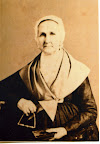
A few years back, when I took up this genealogical quest, Grandma sent me a folder full of material pertaining to her lineage. She had a photograph of Mary Ann Prickett, née Hudson. She had discovered a house in Medford, where Mary Ann was from, and the house was identified as the" Jacob & Mary Prickett House, 1827." Mary Ann would have been about 20 when the house was built, and indeed her first child was born in 1827. It was a perfect fit!

Except that it wasn't. According to the family bible, Mary Ann Hudson was actually Marian Hudson. She married Enoch Prickett, not Jacob. And she lived her entire married life in Philadelphia, where Enoch built carriages. And if the family bible wasn't enough proof, it's been confirmed by the US Census.

To be fair, Grandma didn't know that my mother had the Hudson family bible; my great-grandmother had had it stuck away in the garage of all places, and my mother rescued it from a trash bin when my great-grandparents moved out of their house on Marlkress Road for the smaller place on Potter Street. And she didn't have census data. All she had was the knowledge passed down that Great-Grandma Prickett was born Mary Ann Hudson in Medford, New Jersey.

I know that my discoveries disappointed my grandmother; she had been so sure, and so happy to visit the home of her "ancestress."

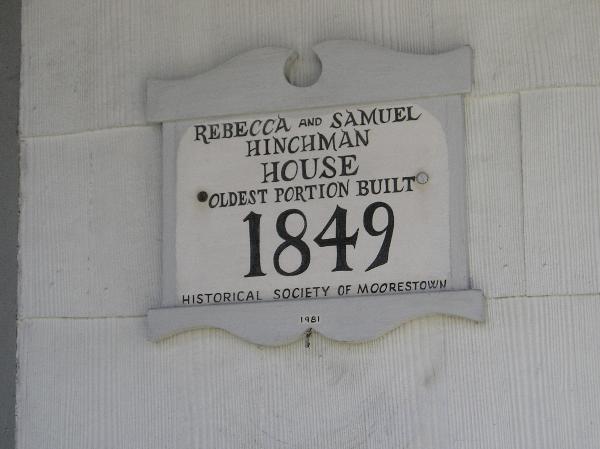
So I was initially excited when a recent web search led me to this: the home of Samuel and Rebecca Hinchman, built in 1849.

You see, Marian's daughter Malvina married Isaac Hinchman. And Isaac was the son of - get this - Samuel and Rebecca Hinchman. And if THAT isn't enough, according to the 1850 census, Samuel and Rebecca Hinchman lived in Moorestown with their children Isaac, Elizabeth and Acshah!

Once again, it looks like a perfect fit!

After all, how likely is it that there could be another Samuel Hinchman with a wife named Rebecca, right?

As it turns out, it's 100%. Samuel M. Hinchman, with his wife Rebecca, are listed in the 1850 Census in Newton Township, which is just south of Moorestown. He's two years younger than our Samuel.

Now I know what you're thinking: OUR Samuel was living in Moorestown a year after this house was built, and the OTHER Samuel wasn't. So why don't I think that this is our ancestral house?

First, because our Samuel was dirt poor. In 1850, his occupation is given as "laborer," which is the lowest paying occupation there is. He didn't have a craft, or property. He showed up at farms, or warehouses, or wherever, and did whatever physical work needed doing. According to the 1860 census, he was working for Lydia King of Haddonfield, as a live-in chauffeur. He probably slept in a carriage house in back of her home, a common practice for servants of the day.

Second, because the Historical Society mentions that this Hinchman family has ties to the Lippincott and Stokes families - something we don't have. And believe me, I'd know if we did.

It's possible that I'm wrong, and that Samuel DID build this house - or at least the oldest part of it - and his fortunes had changed by the time of the census. It's possible. But I got no proof.

I'll keep this tucked away; maybe I'll find a connection to this house in the future.

A MINOR MYSTERY SOLVED
We're connected to the Hinchmans by way of Isaac's daugher, Marian, who married Winfield Felten. Marian, of course, was named for her grandmother. She had a brother, Clinton Starn Hinchman.

As long as I can remember, his name has always been just that: Clinton STARN Hinchman. It's never just "Clinton" or "Clint." "That handsome man? That's Clinton Starn Hinchman, he's Grandma Marian's brother!"

I tried to figure out what the connection was; there had to be one somewhere. Are the Starns cousins, perhaps? I wondered.

I looked and researched and dug and couldn't find any hint of a marriage between a Hinchman or a Starn anywhere. Sure, I found lots of Hinchmans. They owned most of Cherry Hill. I found loads of Starns: there were about as many Starns as Hinchmans in Camden County, back in the day. But nothing definite.

Until last night. My latest Ancestry.com search turned up an entry in South Jersey : a history, 1664-1924.

I knew that the Hinchmans were members of Trinity Methodist Church: I found an invitation to Roland Hinchman's funeral tucked into the family bible, and the service was held there.

But last night, I learned that Isaac Hinchman was one of its founders. And at last, the Starn connection is brought to light.

On page 372 of Volume One, we learn the following:

"The first church erected in the borough was the Trinity Methodist Episcopal Church, incorporated March 11, 1865 by David S. Stetson, A.G. Cattell, Matthias Homer, Elijah G. Cattell, Isaac Starn, Charles W. Starn, James C. Fenn, Isaach Hinchman, and Joseph H. Starn."
Which Starn was Clinton named for? I don't think it matters; Isaac would have been good friends with all of them. Creating a church forges a community; these people would have been one big family, connected by their common faith.

Saturday, March 1, 2008

Uncle Doc

My grandfather, Pop-pop Joslin used to tell us stories of his "Uncle Doc." He was a society doctor in Asbury Park, back at the turn of the last century, he knew Arthur Conan Doyle, he was the first man in town to own a car.

Dr. James F. Ackerman was all that. He was born in Nashua, New Hampshire, to Joseph Ackerman and Susan Reed. His father was a successful provisions dealer. Uncle Doc attended Amherst, but left to pursue a medical degree at Homeopathic College and Hospital in New York City. In 1890, he graduated and spent a year in Vienna. In 1891, he joined the practice of Dr. Bruce Smith Keator. Dr. Keator's health caused him to step down later that year, and Dr. Ackerman took it over.

The son of an astute business man, Uncle Doc inherited a strong business acumen; he was on the board of several corporations, including at least one bank. His efforts led to the creation of Fitkin Hospital in Neptune Township, which is still in operation to this day.

According to my grandfather, Uncle Doc was sitting in a train car at a station in New York City, reading a new book of stories about a fictional detective. Engrossed as he was, he couldn't help but notice an agitated man on the platform outside the train who kept looking in the window at him. A moment later, the man boarded the train and came into Uncle Doc's cabin.

"I say," he said, "I can't help noticing that you're reading that new Sherlock Holmes book, and I was curious to know how you find it." Uncle Doc offered that it was a fascinating story, very original and inspiring.

The man's face erupted into a grin; "Delighted to hear it! Forgive me for my interruption, but I had to know; I wrote it, you see; please allow me to introduce myself, I am Arthur Doyle!"

They quickly ascertained they were both men of medicine, and my grandfather maintained they corresponded off and on, and would occasionally meet up at medical events in New York and Washington DC. ( I have not been able to corroborate this story, but I am working on it!).

He married Ann Rouse in 1896. Annie was the daughter of Martin Rouse of Jersey City, himself an American success story. Rouse started off as a cooper, worked his way up to chandlery, and eventually was a partner in Goulard and Rouse, with offices on Wall Street, Chicago and St. Louis, and served on the board of the Produce Exchange for many years. Rouse's oldest son, John, married Transylvania Ludwig, the daughter of wealthy sea captain and merchant Capt. Joseph Ludwig.

John and Transy had three children together(Transylvania, Wiliam Martin, and Hattie), but the marriage didn't last. Aunt Annie and Uncle Doc took in John's two daughters and son for a time. They gave the girls all the advantages a debutante would expect at that time, and even celebrated the girls' "coming out." They became young Tranny's favorite aunt and uncle, and after she married Stew Joslin, they and their son, Stew Jr., were frequent visitors to 1001 Grand Avenue, Asbury Park. When Stew Jr. had trouble getting accepted at a college, Uncle Doc arranged for him to attend Amherst.

One year at Thanksgiving, my grandfather and some neighbors were discussing first cars, and my grandfather told us about Uncle Doc's car. "It was the first car in town, and the only car in town for several years. I remember they'd put it up for the winter in the barn. Oh, no, you couldn't drive a car in the winter back then: you'd jack it up to save the tires, and empty the radiator, and cover it in blankets to keep the dust off. In that season, he'd use the horse and carriage, which he did most often, anyway, because it was more reliable."

My grandfather also reported that Uncle Doc delivered the illegitimate daughter of Warren G. Harding; a story echoed by at least one of Harding's biographers. While I haven't determined the truth of that, his Amherst biography does indicate that among his achievements, he belonged to the US Secret Service; an odd membership for a doctor!

He died in 1936, and his obituary appeared in the New York Times, including the picture above.

Wednesday, July 4, 2007

For Independence Day: our Revolutionary Ancestors

I have already outlined how Joseph Henry Ludwig fought in the Revolutionary war. That's on my mother's side.

But there may be Revolutionary roots on my father's side as well.

What We Know:

I can firmly establish our line back to James McDermond (b 1818) of Chester County, PA. He first appears on the 1840 Census for West Vincent, Chester, Pennsylvania. I can follow him to the 1880 census, and show that Ulysses Simpson Grant McDermond is listed as his son in the 1870 and 1880 census. James was born in Pennsylvania to parents born in Pennsylvania. His wife was Hannah Thomas, of West Narntreal, Chester County, PA.

What I believe:
The 1850 census ALSO shows another James McDermond living in Chester County. This older James was born in 1798 in Pennsylvania, to parents born in Pennsylvania. This James lived in West Narntreal; the same place the younger' James' wife is from.

To recap:
  • We have two James McDermonds living in Chester County.
  • We have an older James McDermond living in West Narntreal.
  • We have a younger James McDermond living in West Vincent.
  • James McDermond of West Vincent is married to a woman from West Narntreal.
While this isn't conclusive evidence, the circumstantial evidence is pretty convincing.

Pushing Back Further:
In the 1800 census of Chester County, there were two McDermond households: only John McDermond had children; the other, Joel, may have been the eldest son (male was born between 1775 and 1785).

John McDermond was born sometime before 1756, his household had four boys born between 1790 and 1800, four boys born between 1785 and 1790, one male born between 1775 and 1785. There were two women born between 1775 and 1785, and another born between 1756 and 1774.

Probability:
  • John is the oldest male, his wife the oldest female.
  • The second oldest male is his son or SIL, one of the secondary women is his DIL and the other his daughter.
  • The youngest boys may be his grandsons, the slightly older boys may be a combination of grandson and sons.

Conclusion:
  • We have a McDermond household in Chester County, there is a boy in that household who was born in the right frame of time; there is a high probability that one of those four boys is the elder James.
  • We have a McDermond old enough to have fought in the Revolution; if John was born in 1756, he'd have been 20 years old when the Revolutionary War started.
That just leaves the question, "Was there a McDermond who fought in the Revolution?"

And the answer is "yes."

There is a pension for John McDermond of PA for fighting in the Revolution. His pension started 4 September 1791, per a law enacted 7 June, 1785. He died 25 April, 1809.

Not enough to file a DAR claim, but it leaves some solid avenues to explore.

Sunday, June 10, 2007

Father's Day: a look back on my Father's fathers.

In honor of Father's Day, here's pictures of fathers along my father's line.

Dad with me and Jennifer, just about 40 years ago.


Louis Albert Jahn (with Benji) 1996.


Louis Albert Jahn, about 1947. I like the fact that he's standing in more or less the same place in both photographs, and he's with a dog in each of them.


Frederick John Jahn, abt 1952.
This picture was a big deal because he didn't swim much once the kids came along. He had just finished installing the "mercury tank" (a water tank painted black placed on the roof) for the outdoor shower. This wasn't a luxury: it was to get the kids to rinse off the salt and sand BEFORE coming into the house.


Albert Maxwilliam Jahn, around 1923. This isn't a very good picture of him because I had to crop it out of a group shot. Most of the photos I have of him are from a distance. But it gives you an idea of what he looked like in his prime.

Here he is 30 years later:

Albert M. Jahn, abt 1951


Frederick Henry Jahn, about 1900


A closer shot of Frederick Henry, taken around the same time.

Sunday, May 13, 2007

Mother's Day: a look back on my mother's mothers

It's mother's day, and here are shots of mothers along my mother's line:


Mom with Tim, 1967. This shot says 'motherhood', and I think it's one of the best pictures my father ever took.


Mom's mother, Virginia Tibbit Joslin. Standing next to, well, Mom.


Virginia's mother, Elsie, pictured with my mother (Nancy) and William H. Tibbitt.


Elsie Felten Tibbitt's mother, Marian Hinchman Felten, holding Virginia Tibbitt.


I don't have a picture Marian's mother, Malvina Prickett Hinchman, but I DO have a picture of Marian's grandmother, Mary Ann Hudson Prickett.


If somebody has pictures of the Hinchman clan, please let me know.

Monday, May 7, 2007

Susan O'Brien Grant

As you may know, Susan lost her battle with cancer on April 30th. Unfortunately, I couldn't make it to her memorial service. She has been in my thoughts, as have Bobby and Bob, and my aunt and uncle. I am regretful that this life I have chosen so often keeps me far from family, and that I cannot always be there to stand with family during times of trial or tribulation. But family is never far from my heart, however many miles stand between us.

Bobby married Susan about a year before I moved to Florida, so I never really had a chance to spend a lot of time with her. My trips home have been infrequent, and brief. On at least one occasion, her illness kept her in bed while I was in town.

I remember the wedding, on a hot August day. I remember Bobby quietly saying "I do" in a gentle and reserved manner. And I remember Susan's "I DO!" ringing through the church all the way to the back row; she knew how to play to the back row. I remember her dancing at the reception, all flaming red hair and flashing smile as she whirled around the dance floor. I don't believe I have ever seen a more joyful bride. I can't swear that I have seen a person as joyful, period.

There was at least one Thanksgiving, and possibly a Christmas dinner or maybe two. There was my sister's wedding, and then my dad's wedding reception celebrating his marraige to Jocelyne. I remember an easy smile, and eyes ready for laughter.

I wish I had had the chance to see her onstage, and I wish that there more family dinners. But like all of us, I just wish there were more times with Susan. But she brought joy with her, and we must not let that joy fade away; I will remember the laughter in her eyes, and I will find that easy smile in my heart.

Bless you, Susan, and thank you for being a part of our family.

Pop-pop and Mom-mom

I was digging around for a picture of Susan Grant (which I failed to find) but found these and realized I haven't posted anything to this blog in awhile.

Friday, December 15, 2006

Al Jahn, Margaretta Fisher Jahn, and the Starrets

I scanned some more family photos this summer while I was visiting Aunt Dorothy. I asked if there were any shots of Margaretta Fisher, and she pulled out a photo and said "here she is with the Starrets." It wasn't until I was back in Florida that I realized that the man standing to the side was Al.


Here's a good shot of Albert Maxwilliam Jahn in his prime. This is taken at some point in the 1920's. It was cropped from a shot of him, Margaretta, and the Starrets, posing with a newborn.


This is the only photo I have
so far of Margaretta Fisher Jahn.
She's holding Bob Jr, which
would put this photo around 1923.


The original photograph. Aunt Helen (Steele) is sitting on the ground.

Joseph William Ludwig

I found some new details about Capt Joseph Ludwig. I've been trying to fully document the line for a DAR application, and was trying a few new avenues of research. I found a post to a mailing list that led me to information I should have had, but somehow missed.

WHAT WE KNEW:
He was a ship's captain, born in Waldoboro, Maine. The Ludwigs came over with General Waldo in 1753. The patriarch (Capt Joe's great-grandfather), Joseph, (1699-1753) died enroute. His wife and three children - two sons and a daughter - continued the journey and helped found Waldoboro.

Capt. Joseph's grandfather was Joseph Henry Ludwig, who fought in the Revolution under the command of his brother, Jacob. They both served as councilmen for the town, and Jacob served as a Justice of the Peace.

Capt. Joseph's father, John, died when Joseph was 6 years old.

Capt Ludwig appeared on the 1850 Census in Boston, the 1860 Census in New York City, and the 1870 Census in Jersey City. In 1850, he was a "mariner," but by 1860 he was a ship's captain.

Capt. Joseph married Catherine 'Cate' Post, and had a daugher, Transylvania. Transylvania married John Rouse of Jersey City, and they had a daughter, which they named Transylvania Gifford Rouse.

WHAT'S NEW:
I found a lot of my data on him in a genealogy of the Ludwig family. BUT I did NOT read all the way back to find his brief biography, all I got was his lineage, and family data. A few lines in the first half of the book. I thought I did well. But I missed the juicy bits.

The book is "Ludwig Genealogy : sketch of Joseph Ludwig, who was born in Germany in 1699, and his wife and family, who settled at "Broad Bay," copyright 1866.

Turning to page 113, we learn:
  • Not only did he command ships, he owned several of them.
  • He commanded a 'government steamship' for the Union during the War Between the States.
  • In February 12 of 1866, he bought the Vicksburg and Shreveport Railroad at auction for $50,000.
  • As of 1866, he is reportedly retired. He was 45 years old at that time. Not bad.
So he was really well off. And this fits with the quality of the center table that has been passed down; it is an extremely fine work of Victorian Aesthetic.

NEW DATA THAT'S TURNED UP:
So with new data, I began researching him to see what else I could find. And what I found was his death notice, published in the Brooklyn Eagle on July 9, 1870:
July 7, 1870 Capt. Joseph W. Ludwig, 49, of Jersey City

My next challenge is to find out where he is buried.